
With the 2026 Rally Japan upon us, let’s take a look back at the country’s WRC debut, back in 2004!
Rally Japan is upon us! The WRC is ready for another journey on the ”Land of the rising sun”, with Elfyn Evans leading the way in the driver’s championship standings, as he attempts once more to end the ”curse” and lift his first WRC title, in what largely has been ”The Toyota show” thus far.
When it comes to Japan and motorsports, what first comes to mind often is the on/off Honda relationship with Formula 1, the iconic WRC cars of the late 90s and early 2000s, or the absolute domination of 500cc/MotoGP from Honda, Yamaha and Suzuki, up until 2019.
As to hosting events, not many people’s first thought goes to rallying. There is the Japanese Grand Prix in Formula 1, held (mostly) at the fan favourite Suzuka circuit. There is also the motorbike counterpart, held at Mobility Resort Motegi.
Follow Motorsport Storyteller on Facebook
Both have large history and legacy. Rallying events… not so much. Although there were rallies in Japan as early as the 1950s, with the advent of the Japan Alpine Rally, the country had little impact on the world stage, aside from its cars.
That all started to change in the early 2000s, when Rally Hokkaido, hosted on the eponymous northern island, joined the Asia-Pacific Rally Championship in 2002. This was Japan’s first ever international FIA championship event in rallying and was a largely succesful one. In 2003 the second edition was held, but this time as a candidate event for the WRC.
In 2004, the country was finally chosen to officially host the 11th round of the championship. At the time when the cars, drivers and crews descended upon the island of Hokkaido, the standings, premonitious to the future of the sport, were as such:
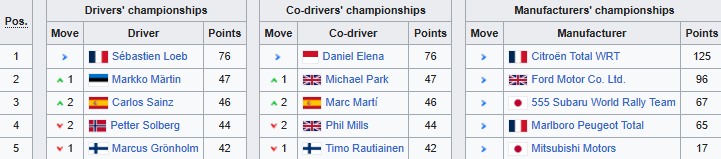
In what would be a familiar sight in subsequent seasons, Sébastien Loeb was romping towards his first WRC title after coming so close to it in 2003, 29 points ahead of 2nd placed Markko Märtin.
This might seems like he, alongside co-driver Daniel Elena dominated in the first 10 rounds, but this would be misleading, as 4th placed Petter Solberg was only five points behind the Frenchman after the Norwegian’s Acropolis Rally win, in round 6. His title bid had though unraveled, as after a 3rd place in Rally Turkey, where Loeb won, he and co-driver Phil Mills suffered three retirements in a row, these being in Argentina, Finland and Germany.
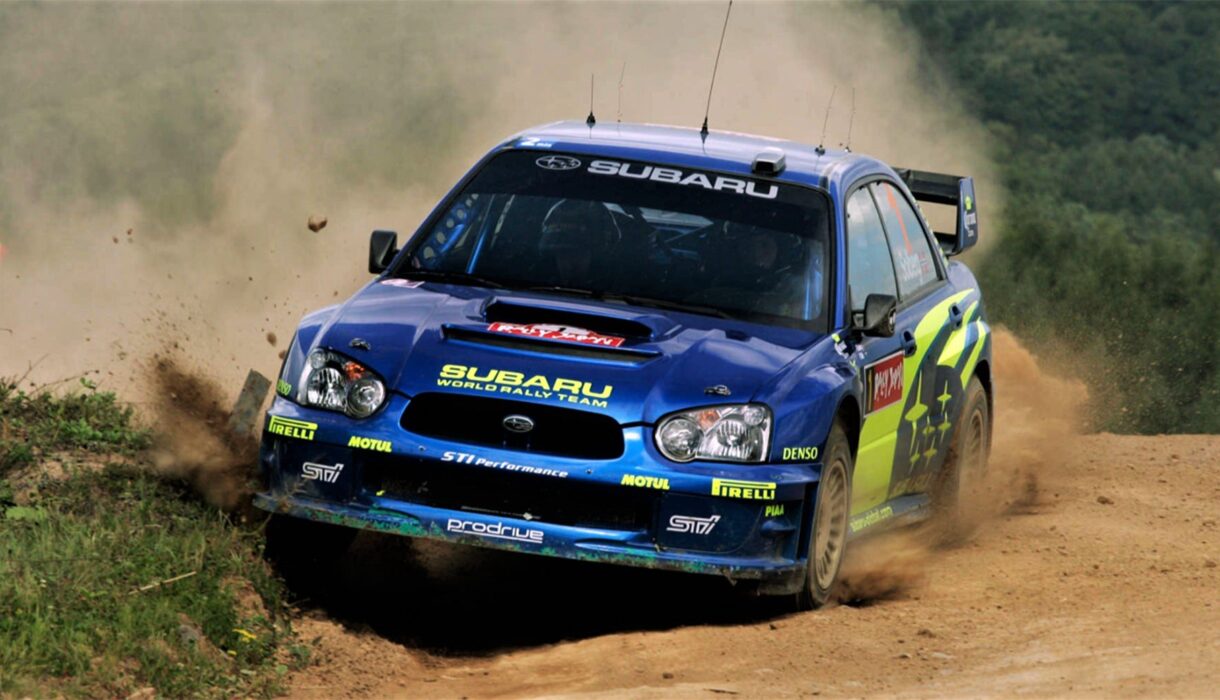
The latter was a massive crash on the Panzerplatte stage, when he slid wide on a fast left-hand corner, sliding onto weeds and unfortunately hitting a hinkelstein, that propelled the Subaru Impreza into a series of rolls, destroying it, with the pair of Solberg and Mills fortunately surviving relatively unharmed.
The reigning champion though was unfazed and with his trademark ”never give up” attitude, set his sights quickly on Japan. When he and the other drivers arrived and witnessed the stages up close, two things quickly came into their minds. ”Fast and narrow”.
Another topic of discussion before Rally Japan was the future of François Duval. The then 23 year old had just found out that he was out of his Ford contract at the end of the season, due to uncertainty surrounding M-Sport‘s future in the series. As a matter of fact Malcolm Wilson had crucial meetings around the days of the rally, regarding what the 2005 budget would look like.
It would not be until November, that Ford fully committed for the next four seasons, but by then it had lost both of its highly touted drivers, with Duval on his way to Citroen, where he would replace the retiring Carlos Sainz and Märtin to Peugeot, in the place of the Mitsubishi-bound, Harri Rovanperä.
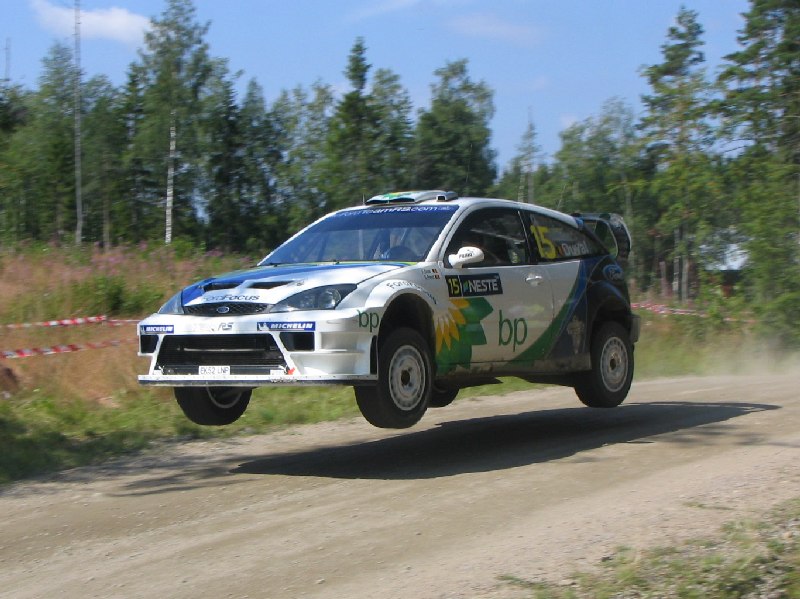
The first two stages of the rally, Yam Wakka 1 and Kunneywa 1, it became apparent that highly motivated to right the wrongs of previous events and on Subaru’s home soil, Petter Solberg was untouchable, building an 18.1 second lead, with Marcus Grönholm 2nd and Loeb in 3rd.
“It’s going very well. Much better than expected. It’s very fun, but it’s very difficult out there. But it’s going the right way”, said Solberg after the opening rounds. After four stages his lead over Grönholm stood at 19.9 seconds and everything appeared set.
Things were not so smooth for all drivers though. Solberg’s teammate, Mikko Hirvonen was down in 7th, 1:09.8 behind, having lost time with a radiator problem. A similar fate befell Grönholm’s teammate, Rovanperä, who had lost a gear, finding himself two whole minutes behind Solberg, in 8th.
Another driver not happy was Märtin, who had lost nearly 40 seconds in four stages, blaming his pace notes for this calamity. ”My notes are really, really horrible”, said the Estonian. ”I don’t know who made them”. Hirvonen also had issues with his pacenotes.
Solberg’s ”better than expected” rally went a little bit north in the afternoon, as a combination of choosing the wrong (as it turned out) Pirelli tyre compound, which was softer than necessary and him encountering a deer in SS6 (Kunneywa 2), meant he began losing time to now 2nd placed Loeb.
The Frenchman won three stages on the bounce (SS5-7) with Solberg fastest on SS8 and Carlos Sainz, the first to break their duopoly on SS9, the final of day 1. After that first day, Solberg now lead Loeb by only 12.7 seconds, with Grönholm only 17.8 seconds away, with a three-way battle for the win seemingly on the cards.
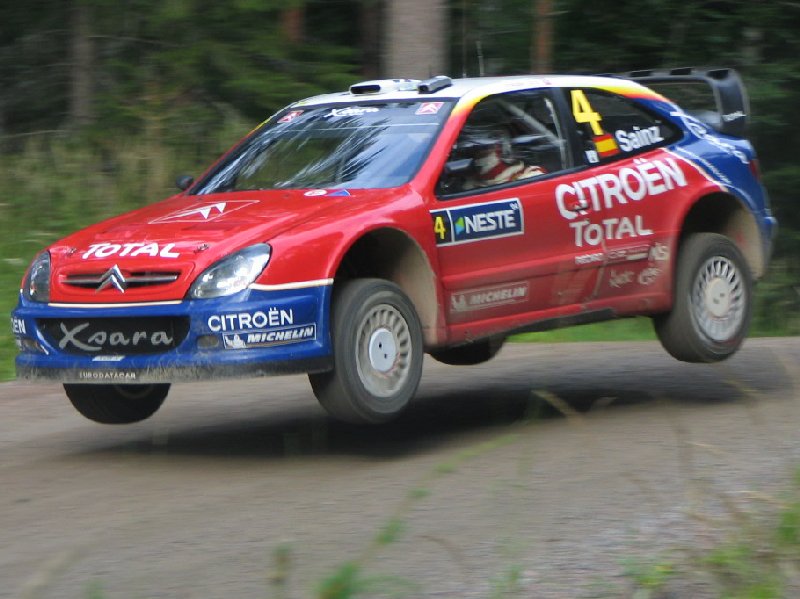
This though proved to be a false dawn as Solberg scampered away on Day 2, with some more wide stages to be raced upon. Winning five straight stages (SS10-14) the lead ballooned all the way to 46.4 seconds by SS14, a puzzling outcome, given that Loeb had the theoretic advantage, the only major WRC driver to have rallied on these stages the year before.
Loeb seemed not too bothered by that, making some complains about the amount of gravel in these stages.
Afterwards the mood at the Subaru camp was enthusiastic. “It was good, no problems at all. We had a good tire choice, went for a small attack of course but I’ve got a good lead now and I’m quite pleased for that”, said Solberg.
Day 2 was also the one in which Grönholm’s hopes of a podium were dashed, as he suffered a gearbox issue of his own, a familiar pattern of the 307 WRC, with Rovanperä having another issue with gearbox gremlins a bit prior to that, despite a gearbox change.
Losing a whole minute of time and dropping to 4th, Grönholm’s patience wore thin, giving us the iconic “I have only one gear,” line, with him responding to the ”Which one” queston by saying ”Three”, simultaneously showing the number with his fingers. Worse still, in SS14 he jumped the start, adding a 10-second penalty to his time.
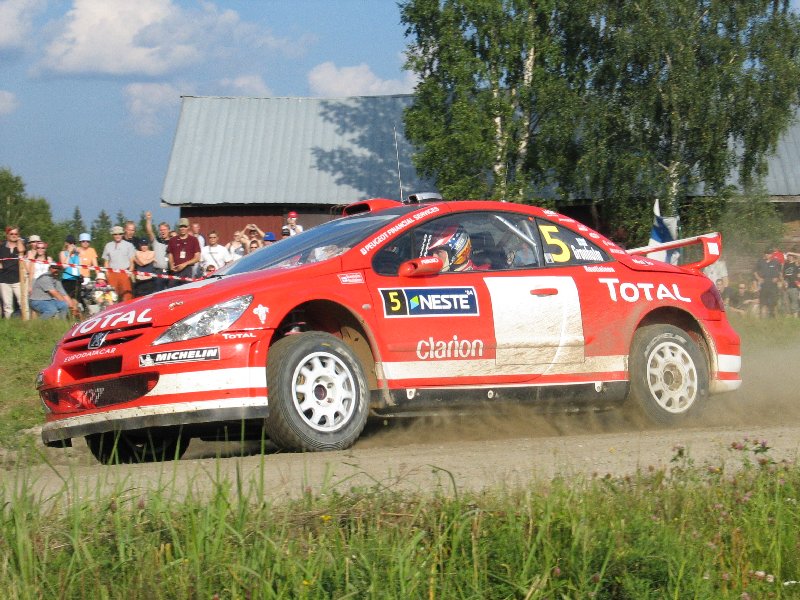
After that stage he was now 5th and when quizzed on the constant problems with the 307 WRC, he simply responded that ”“Don’t ask me. You have to ask the engineers or management.”. When technical director Michel Nandan was asked, he seemed equally bemused by the problems encountered.
”Of course we have a big problem. Yesterday we had a problem with Harri [Rovanperä] where he lost one gear, and today with Marcus the gearbox was stuck on third gear, so maybe a problem [that’s] related. We don’t know yet, but for sure it’s strange”, quipped Nandan.
This proved somewhat motivational for Marcus, as he drove a spectacular (if a bit angry) SS15, winning his first stage of the rally, subsequently regaining 4th from Sainz, the Spaniard only three seconds behind him after SS17.
It would be to no avail though as a wrong tyre choice of his own (as he admitted) and a run-in with a Christmas tree, another classic WRC moment, ultimately meant that Sainz powered ahead yet again, with wins on Saturday’s final two stages (SS19-20), as Solberg slowed down a tad bit, his lead now a minute from the happily 2nd Loeb, who focused his attention on finishing the rally and grabbing the important points for his title bid, especially since a scare in SS18.
The start of the final day delivered a nasty surprise for the spectators eager to see cars pass through SS21 (Rerakamuy 1), as they were evacuated due to the sighting of a brown bear in the nearby mountain.
A stage later and this time bad news were in order for François Duval, who was in touch with the pair of Sainz-Grönholm in the battle for 4th, when he slid into a ditch on SS22, immediately putting an end to his rally.
“The note was too late and the left corner before this corner it was a long, long corner but it’s not long, it was just a slight corner and we went off the road. It’s bad luck for me”, rued Duval, who was driving with a stand-in co-driver, Philippe Droeven, him updating the pacenotes during the stage.
This left once again Sainz and Grönholm in the only battle of importance, as bar any unforseen bad luck or error, Solberg, Loeb and Märtin had their podium places on lock, although the leader seemed stressed, as he had been in similar places beforehand, with luck not besides him.
Some bad pace notes of his own did not help, his only moments of calmness being when accompanied by his wife, Pernilla and their son, Oliver.
His co-driver, Phil Mills, delivered a sarcastic remark, saying: “Well, as somebody else just said, there isn’t really any pressure today, there’s only the 135 million Japanese supporting us today. There is no pressure if you put it like that!”, while laughing.
He did not need to push, as his lead was huge, but he needed to keep the Impreza on the road. That he managed, crossing the line to take his 8th WRC victory, with a gap of 1:13.3 over Loeb.
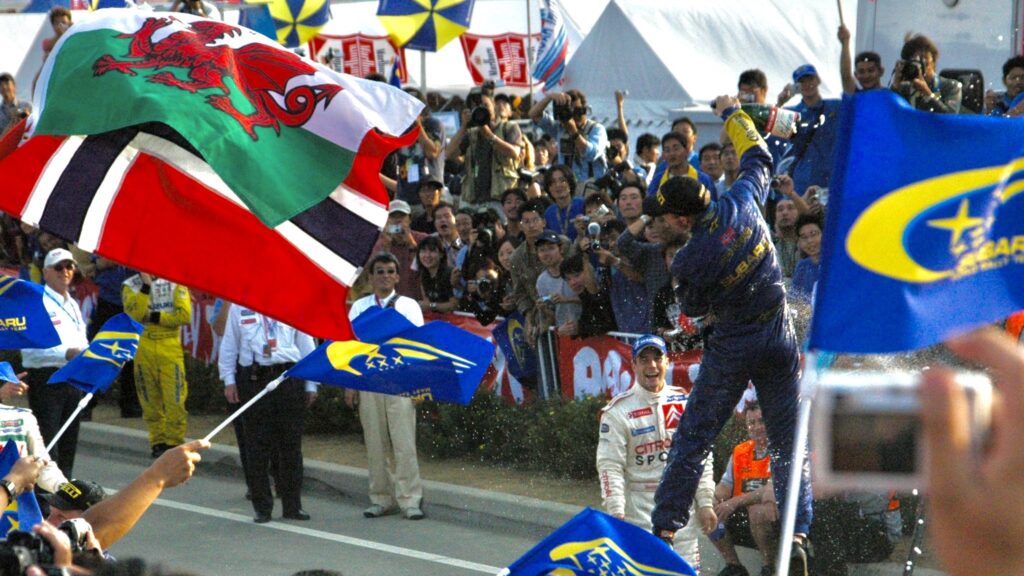
The release of emotion was immediate. Petter Solberg thrust his arm into the air, unleashing his trademark scream of jubilation as he grabbed Phil Mills beside him, the co-driver laughing through the intercommunication. After everything they had endured, the moment carried more than the satisfaction of victory — it was relief, vindication, and a return to the summit they feared might have slipped away only weeks before.
“Not a bad weekend, eh?” Mills joked. “So happy, Phil,” Solberg replied, still overcome with emotion. “After Germany, we’re right back on the top again.”
“Absolutely.”
As the Impreza rolled into service, Solberg leaned out of the car and playfully worked the throttle, the engine barking in celebration. Around them, the atmosphere was electric. It was obvious how deeply this win resonated — not only with Solberg and Mills, but with the entire team that had stood behind them through one of the darkest moments of their season.
“I must say it was better than expected,” Solberg admitted afterward, his voice still heavy with emotion. “After the crash in Germany, I honestly never thought I could come back so quickly. It was a horrible accident, and Phil has been absolutely excellent — even better than before… oi, oi, oi.”
The joy was raw and unfiltered, the kind that only comes after doubt, fear, and the hard climb back from disaster. Solberg has subsequently named his 2004 Rally Japan triumph, as one of his all-time favourite wins, with him posting about that once a year, whenever the WRC world shifts attention to the far east, still grateful for that amazing experience.
Behind the happy to only lose two points Loeb, Markko Märtin completed the podium with that 3rd place being his sixth podium finish of the season. Marcus Grönholm grabbed 4th after a brilliant final day, in which he won the last four stages (the last tied with Märtin), leaving Carlos Sainz in 5th.
Behind them, finished the two unlucky Finns, with Rovanperä in 6th and Hirvonen, who encountered hydraulic problems in SS24, having to push his Subaru towards service in order to repair it, in 7th. The final points position (8th) went to Antony Warmbold, with the privateer entry, driving a Ford Focus RS WRC 02.
After Japan, a revitalized Solberg went on a three rally win streak, beating Loeb in the Wales Rally GB as well as Rally Sardegna in Italy, though Loeb’s lead was already far too great to overcome, with a 5th place finish for Solberg and a fourth straight 2nd place for the Frenchman in the Tour de Corse, meaning he mathematically clinched the first of nine consecutive titles, with two rallies to go.
If your reached this point, i truly and honestly appreciate this. If you liked it, make sure to share it with your fellow rally and motorsport enthusiasts!